
Watch your team plan, communicate, and execute, under pressure
The Afterburner LEGO Challenge is a hands-on team-building experience designed for sales kickoffs, leadership offsites, and annual conferences.
Sixty or ninety minutes. 5 to 2,000 participants, in-person, facilitated by fighter pilots who have run 3,500+ organizations on six continents. The kit ships, the room reconfigures, the plan changes mid-mission.


What’s the LEGO Challenge in 60 seconds
Team building for teams that don’t have time for games
One LEGO set. Twenty-minute build. The debrief is where the work happens.
The Afterburner℠ LEGO Challenge compresses the Flawless Execution℠ cycle into a fast-paced simulation that surfaces how your team actually communicates under pressure, and debriefs it in the room.
What teams walk away with
- Teams see their own communication patterns under pressure.
- Plan-Brief-Execute-Debrief becomes muscle memory.
- Cross-functional friction surfaces and is debriefed in the room.
- Energy and engagement spike for the rest of the event agenda.
How does the LEGO Challenge run, step by step
Under the bricks, teams run FLEX℠, the Flawless Execution cycle Afterburner has been installing across enterprise leadership teams for 30 years: Plan, Brief, Execute, Debrief. The build is the cover. The cycle is what gets installed.
-
Step 01
Prep call
Strategic context, sector specifics, team grouping, and constraint design all get aligned to the event objective. No surprises on the day.
-
Step 02
Plan
Teams form, the room is briefed on the mission, and each table runs a compressed planning sequence against the build objective.
-
Step 03
Brief
Each team’s leader briefs the build out loud to the team before a single brick is touched. The build does not start until the brief lands.
-
Step 04
Execute
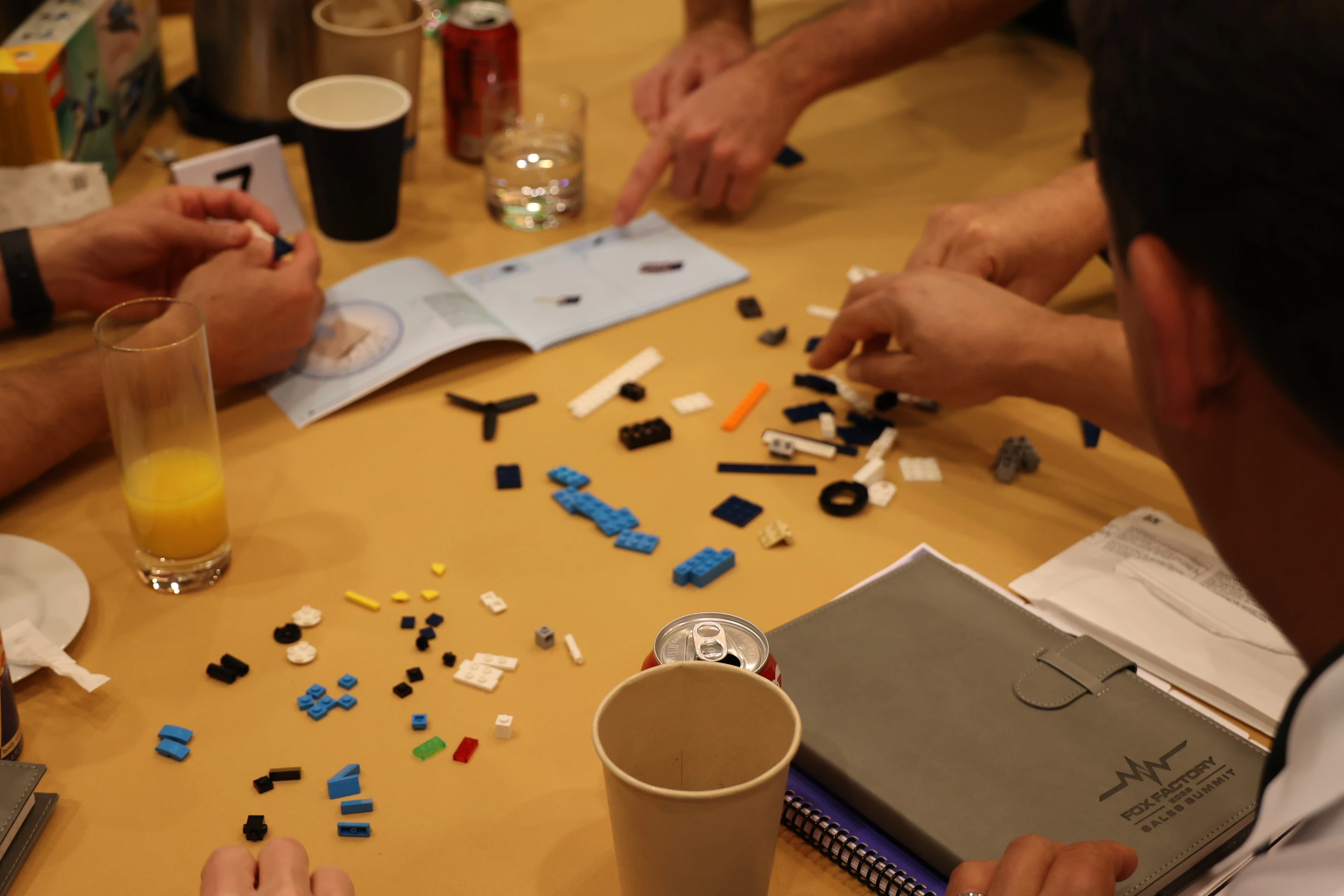
The build runs under time pressure with a public outcome. Mid-mission, the pilot injects a constraint shift the brief didn’t account for. Teams adapt, fall behind, or rework. The clock does not pause.
-
Step 05
Debrief
Every team runs the ORCA debrief (Objective, Result, Cause, Action) on the mission they just executed. The most senior leader at each table goes first. The full breakdown is unpacked below.


What kinds of constraints can the pilot layer in
Each LEGO Challenge runs with one to three constraint types, layered in by the pilot and chosen in the prep call against the event’s objective. The four families below map to the most common event goals.
PLANNING RIGOR
Teams receive a defined target and build to match. The constraint tests planning rigor and brief discipline. Booked for launches and rollouts where the destination is fixed and the gap is execution.
ADAPTABILITY UNDER CHANGE
The spec changes mid-build. Teams replan against new information without restarting the build. The constraint tests adaptability and the discipline to update the brief without losing the team. Booked for reorgs, merger integrations, and product launches where the goalposts move.
PRIORITIZATION UNDER SCARCITY
Mid-build, components get traded, lost, or reallocated across teams. The constraint tests prioritization and negotiation under scarcity. Booked for sales kickoffs and leadership offsites where teams operate in silos and need to feel the dependency before the quarter starts.
CROSS-TEAM COMMUNICATION
Team builds are not independent. Outputs connect, dependencies span tables, success requires coordination across the room. The constraint tests communication structure across silos. Booked for annual conferences, post-reorg alignment events, and engagements where the buyer’s core problem is functional fragmentation.
What size groups does the LEGO Challenge run for
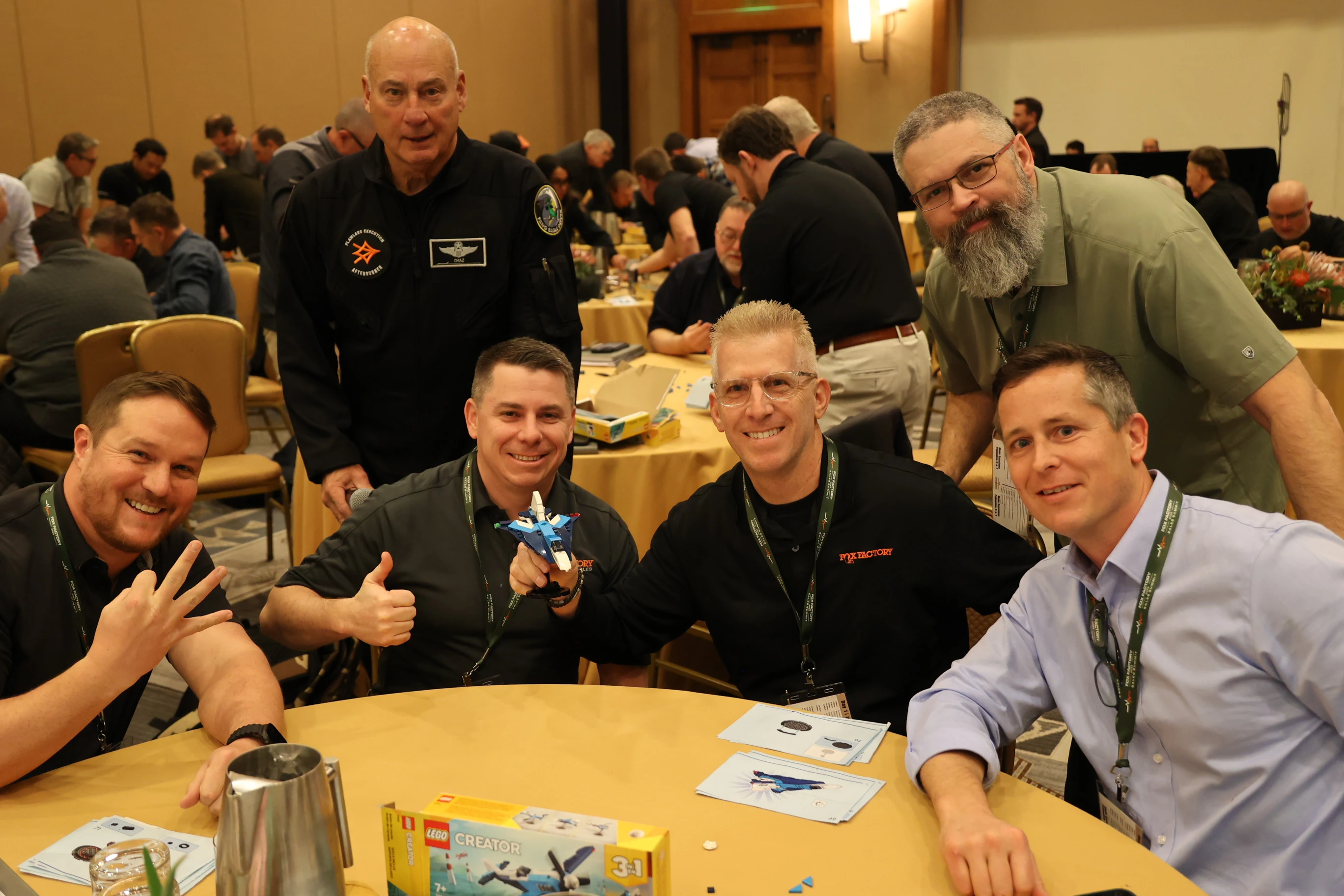
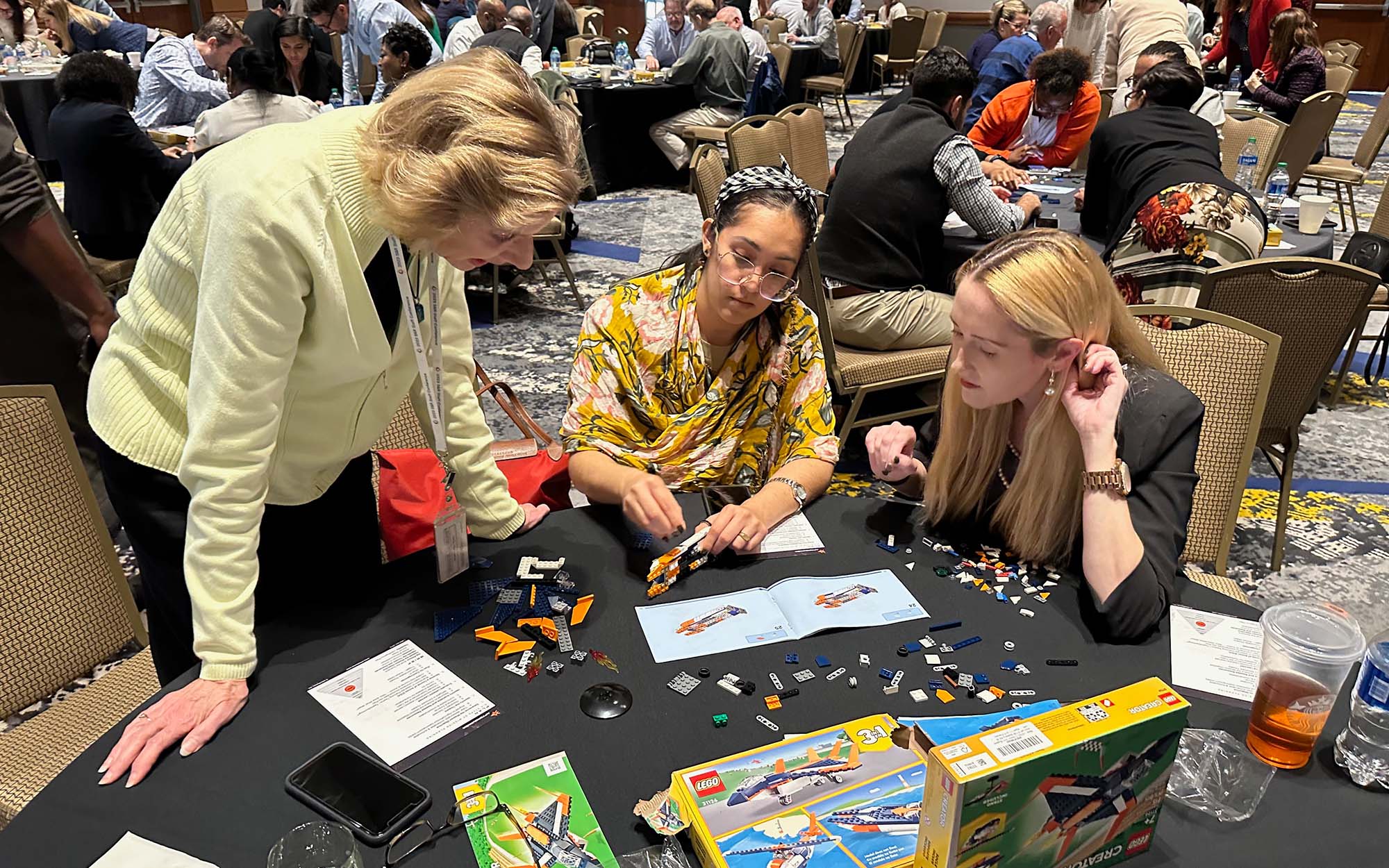
The Challenge runs for 5 to 2,000 participants, in-person. Multiple teams per room, with table dimensions confirmed in the prep call. For events of 100+, the room runs many tables in sync with multiple pilots facilitating. The mechanics scale; the discipline does not bend.
Grouping logic gets designed in the prep call against the booking team’s strategic context. Who sits with whom, who shares a constraint, who competes against whom. Default is mixed-function tables. Common variants: by leadership level, by department, by region, or by intentional pairing of teams that do not usually work together.
WHAT IT TAKES TO RUN THE LEGO CHALLENGE
What Afterburner brings
The LEGO Challenge kit. Pilot facilitation. Constraint design specific to your event. Photo capture before takedown, so teams leave with a record of what they built.
What the venue provides
Room with rounds-style seating. Tables (one per team). Standard event AV. Aisle access for the pilot to move between tables.
What gets confirmed in the prep call
Table dimensions, pilot count, exact constraint mix, kit specifics for your room. No surprises on the day.
After the event
Builds get photographed. Kit packs up. The room is restored. In the prep call, you decide whether the team keeps the build or the kit ships back.
How does the ORCA debrief work
ORCA runs on the mission the teams just completed, with the most senior leader at each table going first. The debrief is where the LEGO Challenge stops being a team-building exercise and starts being a leadership intervention.
Where the debrief discipline came from
In the cockpit, every mission ends in a debrief. Rank gets removed. Hierarchy gets removed. The practice has a name: Nameless and Rankless. Afterburner founder James D. “Murph” Murphy brought it out of the cockpit in 1996, and the company has installed it across enterprise teams for 30 years. When head coach Tom Coughlin brought it to the New York Giants, it was Murphy on the ground teaching it, and the Giants won Super Bowl XLVI. Today, CEO Rob “Rocko” Ceravolo, a U.S. Navy fighter pilot and TOPGUN graduate, leads the organization, having lived the practice before he taught it.
Why it works on a LEGO build specifically
A LEGO build is a physical artifact. The objective is visible. The result is visible. The gap is visible. There’s nothing to argue about. The debrief moves directly to cause, and cause moves directly to action.
Take it back to the organization
The debrief is portable. The Flawless Leadership℠ Assessment shows where your team’s execution is breaking down before you scale the fix. Teams that want to install ORCA across the organization start there.
Take the Flawless Leadership Assessment →Voices from the build
85% of Afterburner clients rebook. Written voices from the room below.
“I had a great time. It was awesome. I’m looking forward to learning from all these different departments and different people that I’m meeting today and just making sure we don’t leave anybody behind.”
“I’ve had fun today. Very, very engaged. It was an honor to work with the men and women who have fought for this country at a very, very high level and, some great takeaways today.”
“You guys were right on point, I ran out of paper and had to start taking notes on my hand!”
For bureau partners
Booking through a bureau? The Speakers Bureau Portal covers positioning language, named outcomes, current bios, and downloadable assets. 85% of Afterburner clients rebook, bureau-placed engagements included. Bureau placements are turnkey on our side.
Speakers Bureau Portal →Tell us about your event
Tell us your event date, audience size, and what you’re trying to achieve. A pilot replies within one business day.
Frequently asked questions
What is the Afterburner LEGO Challenge, and how does it work?
The Afterburner LEGO Challenge is a hands-on team-building experience that compresses the Flawless Execution cycle into a 60-to-90-minute simulation for 5 to 2,000 participants. Teams plan, brief, execute, and debrief a constrained LEGO build under time pressure. Afterburner has run 3,500+ organizations on six continents over 30 years.
What’s the difference between the 60-minute and 90-minute formats?
The 90-minute standard runs the full FLEX cycle plus a deeper ORCA debrief. The 60-minute compact runs the same cycle on a tighter clock with the constraint mix adjusted to fit. Both work for 5 to 2,000 participants. Afterburner has run the format at every audience size in that range across 3,500+ organizations.
What size group does the LEGO Challenge work for?
The Challenge runs for 5 to 2,000 participants, in-person. Multiple teams per room. For events of 100+, the room runs many tables in sync with multiple pilots facilitating. The mechanics are the same regardless of audience size; what scales is table count and pilot count. 85% of clients booking at this scale are Fortune 500.
Why is the LEGO Challenge in-person only?
The build is a physical artifact. The room dynamics, the constraint shifts mid-mission, and the most-senior-leader-goes-first practice depend on co-location. Virtual delivery would compromise the mechanics that make the experience work. Afterburner runs other formats virtually across 30 years and 3,500+ organizations; the LEGO Challenge is not one of them.
What does the prep call cover before the event?
The prep call covers strategic context, sector specifics, team grouping logic, constraint mix selection, and kit logistics for your venue. It happens two to three weeks before the event with the pilot facilitating the run. Afterburner has standardized this prep across 3,500+ organizations; no surprises on the day.
Can pilots tailor constraints to our sector?
Yes. Constraint types get chosen in the prep call against your event’s objective and your sector’s specific friction. Across 30 years, Afterburner has worked with 2.2 million leaders in financial services, healthcare, manufacturing, technology, and consumer goods. The constraint mix makes the experience sector-relevant; the underlying approach does not change.
What’s the measurable outcome from running the LEGO Challenge?
Teams leave with the Flawless Execution cycle installed as muscle memory: plan-brief-execute-debrief becomes the default operating mode. Cross-functional friction surfaces in the room and gets resolved on the spot. 85% of Afterburner clients rebook, evidence that what gets installed sticks.
Who books this versus the Top Gun Experience?
The LEGO Challenge is typically booked for sales kickoffs, leadership offsites, and annual conferences where teams need to feel the FLEX cycle quickly. The Top Gun Experience is booked for deeper leadership development with longer-form scenario simulation. Both pair with keynotes when the agenda allows. Same underlying method, refined across 3,500+ organizations; the format and intensity differ.
How does this compare to other LEGO-based team-building exercises?
The Afterburner LEGO Challenge is built around the Flawless Execution cycle, the same methodology installed across 2.2 million leaders over 30 years. The build is the cover; the leadership discipline that gets installed is what differentiates the experience. Pilots facilitating the run are decorated military officers with operational backgrounds.
Ready to brief the mission?
Skip the form. Chat to a Pilot, get a fee range, lock the date.
Chat to a Pilot →