
You plan the Mission, we fly the mission, and together we debrief the mission.
The Top Gun Experience℠ is a high-energy mission simulation built around the Flawless Execution℠ cycle. Teams plan, brief, execute, and debrief together under real-time pressure, with scenarios that test communication, prioritization, and shared decision-making. The simulation makes the framework experiential, not theoretical.


The Top Gun Experience puts your team in command of over forty aircraft to execute a complex humanitarian mission. You have one hour. Are you ready?
Plan. Brief. Execute. Debrief. In the room. On the day. Under pressure.
The conference room falls silent, and red lights illuminate as you transition into your planning bunker. Mission parameters flash on the screen. Your team has limited time to save lives after a small island nation experiences an environmental catastrophe, and everything that can go wrong will. Welcome to the Top Gun Experience (TGX), Afterburner’s signature program, where decades of leadership learning is distilled into a high-energy, high-return experience that drives immediate business impact.
Built from Afterburner’s performance-tested methodology, the TGX is designed to create controlled chaos that mirrors your leaders’ hardest days. Teams navigate shifting market dynamics, incomplete data, and mounting stakeholder pressure while applying the Flawless Leadership℠ planning methodology to achieve mission success. It’s not about simply surviving the chaos, it’s about building the results-generating systems to thrive in it.
-
✓
Teams experience the cost of poor planning and the power of disciplined execution. The stakes inside the simulation are real enough that the lessons land in the body, not just the mind.
-
✓
Behaviors change because participants felt the consequences. Behavior change does not come from a workshop slide. It comes from running a mission, missing the objective, and figuring out why.
-
✓
Debrief skill activates immediately. The structured debrief runs in the room, on the same teams, on the mission they just ran. The first time they use it is not a practice run; it is the real thing.
-
✓
Cross-functional alignment improves measurably. Cross-team observation roles surface the coordination gaps that single-team formats miss. You’ll experience distractions, shifting priorities and resource constraints, and the way of thinking and working that allows you to shift and meet the next challenge.
The scenario types, the scaling logic, and the debrief detail are below.
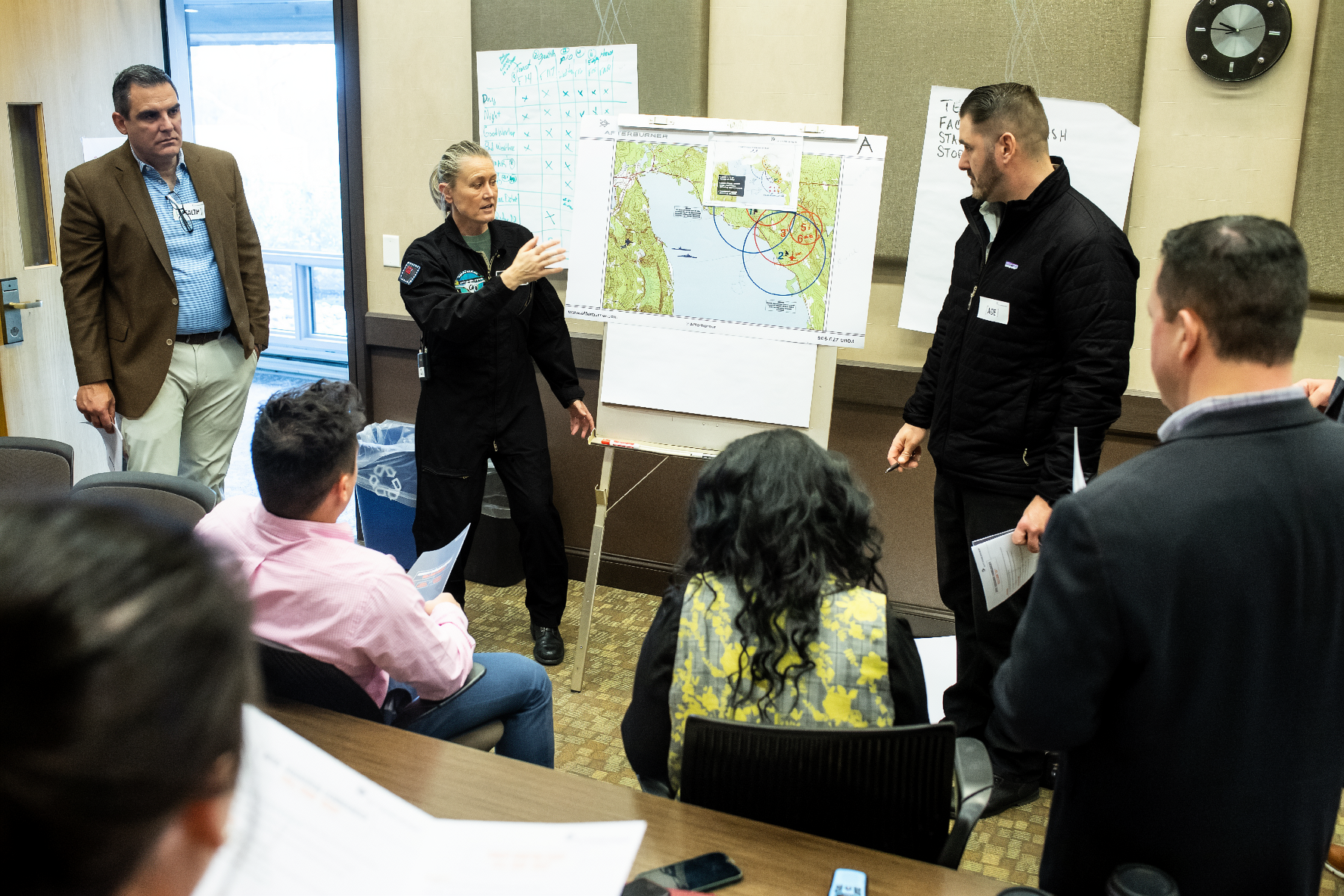
Four scenario types. Tailored to your audience in the prep call.
Top Gun Experience is delivered against four scenario archetypes. The methodology stays the same. The scenario gets tailored in the prep call to match the leadership challenge the booking team needs the room to feel.
Strategy launch.
Teams plan a multi-team launch under conflicting priorities, fixed timing, and threat anticipation. Best for strategy kickoffs, go-to-market launches, and leadership offsites following a planning cycle. Surfaces the gap between a strategy on a slide and a strategy executed by people.
Crisis response.
Teams plan for and execute under a fast-moving disruption with incomplete information. Best for incident-readiness drills, business-continuity exercises, and leadership teams that need to pressure-test their response before a real disruption does it for them. Decision speed and communication discipline both get tested.
Cross-functional coordination.
Teams run a mission that forces multiple functions to integrate with built-in coordination friction. Best for post-reorg alignment, merger integration, and matrix organizations. Cross-team observation roles surface the seams that show up in real handoffs.
Resource-constrained execution.
Teams must hit the objective with constrained time, budget, headcount, or information. Best for leadership teams after a budget cut, growth-stage executives, and any room where prioritization is the real problem. Forces explicit prioritization. The wishlist stays out of the plan.
One scenario archetype is selected per engagement in the prep call, matched to the outcome the booking team wants the room to leave with.
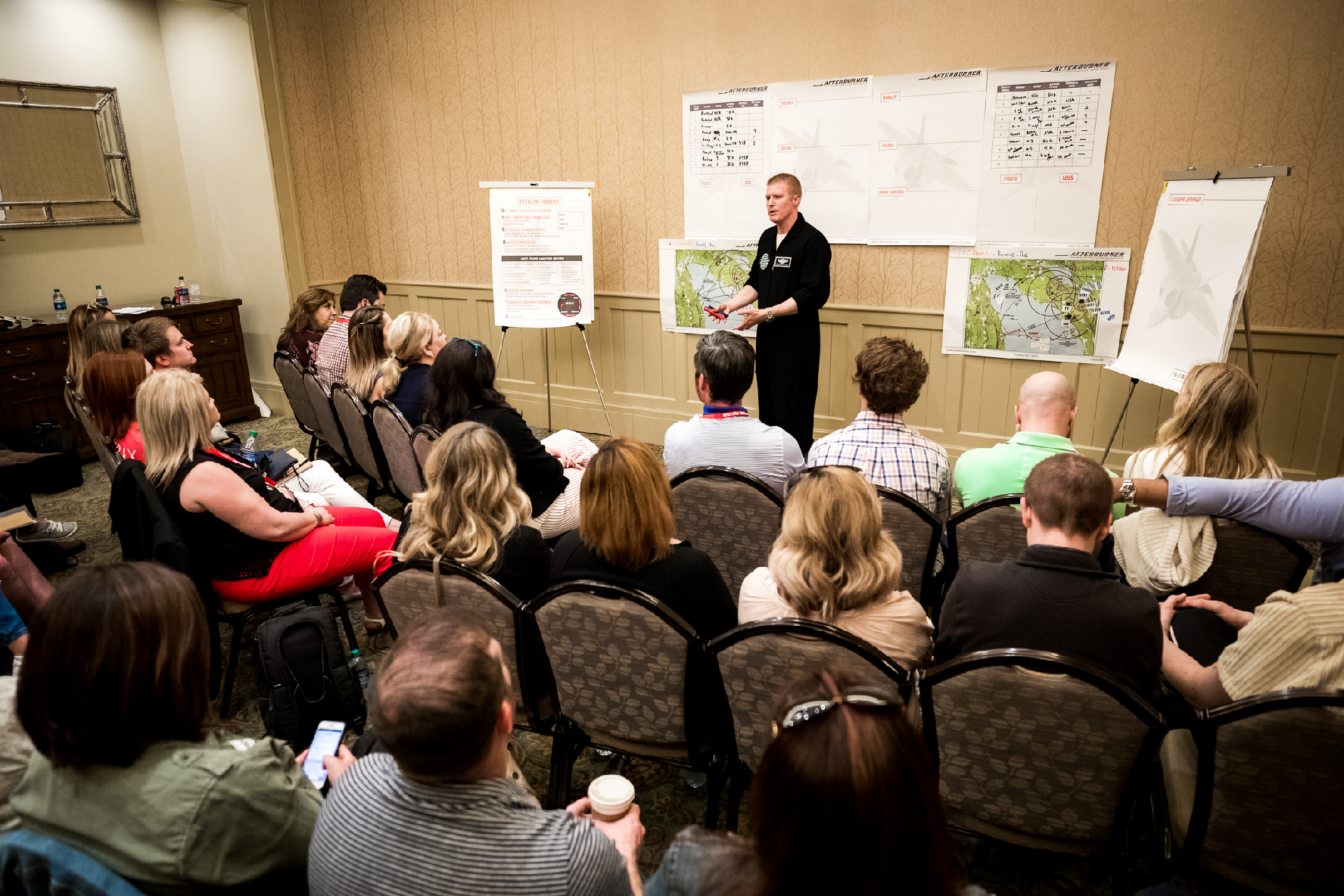
From 5 to 5,000.
The grouping logic, who sits with whom, who observes whom, gets designed in the prep call against the booking team’s strategic context.
Teams of 5 to 8.
Five to eight is the team size that allows real role differentiation while keeping every voice in the room. Larger teams dilute accountability. Smaller teams skip the coordination gaps the simulation is designed to surface.
Multiple teams, one mission.
Audiences beyond a single table split into multiple teams running parallel mission cycles. Each team plans, briefs, executes, and debriefs independently. The cross-team layer surfaces patterns that no single-team format can see.
Cross-team observation built in.
One member of each team rotates through observer roles on adjacent teams. The observer carries back two things: what the other team did differently, and what the observer team did not realize about itself.
The whole room runs the same clock.
Every team hits Plan, Brief, Execute, and Debrief on the same schedule. Synchronized timing makes the cross-team debrief possible. It also forces teams to commit to the time-box rather than negotiate around it.
Reference scaling. A small team runs as a single unit. A room of fifty to a hundred runs as multiple parallel teams. Large general sessions run as mission-planning cohorts of dozens of teams. The format has been delivered at all-hands events of 1,000+ and small leadership teams as small as five.
Where the session actually pays off
ORCA gets run after the pilots return from the mission, with the most senior leader at each table going first. We practice Nameless and Rankless in real time.
ORCA. Four letters. Run in order.
Objective.
What did the team set out to achieve? Stated clearly, in measurable terms. Binary answer: did the team achieve it, yes or no?
Result.
What actually happened? Facts, not feelings. The result gets reported against the objective without spin.
Cause.
Why did the gap exist between the objective and the result? Root cause, not symptom. Named without blame.
Action.
What will the team do differently next cycle? Specific. Owned. Time-bound. The Action becomes the first installation step.
What teams leave with.
-
✓
A written debrief artifact for each team, capturing Objective, Result, Cause, and Action in the team’s own words.
-
✓
One structural protocol the team can install Monday morning, typically a debrief cadence, a brief format, or a contingency template.
-
✓
Cross-team patterns surfaced by the pilot facilitator that no single team would have seen on its own.
-
✓
A High Note close that sends the room out energized, not exhausted.
The deeper facilitation discipline lives inside the Operator and Mastery tiers of Flawless Leadership. The Top Gun Experience installs the debrief as a practice. Ongoing development is the next conversation.
Chat to a pilot →What the room actually said
“Best event we’ve ever had, which is why we had Afterburner come back again this year for our second annual conference.”
Kyle Turner, Global Customer Engineering Leader, Google
“If you were to ask me to rate my experience on a scale of 1-10, I’d give you a 100.”
Jay Bellissimo, Chief Operating Officer, Vonage
“This is the 4th time that I’ve actually worked with the Afterburner group. Each time they far exceed my expectations.”
Brian Alexson, President, Home X Services Group
“My experience was excellent. Having these discussions about mindset shifting is critical.”
Shenia Kirkland, VP of Legal, Vonage
Booking through a Speakers Bureau?
Bureau partners and agents have a dedicated portal with pre-cleared bios, fee letters, calendar holds, and the assets needed to pitch Afterburner keynotes inside the bureau workflow.
The Flawless Leadership Assessment is the entry point
The simulation is the moment the team feels the system. The development practice is the system installed as the way the team operates every week. Both run on the same operating system. The Flawless Leadership Assessment is where teams that want to embed it begin.
Take the Flawless Leadership Assessment →Talk to a pilot about a Top Gun Experience
Tell us about the audience and the date window. A booking-team member returns within one business day with a written recommendation: pilot, format, scenario type, fee range.
What buyers ask before they book a Top Gun Experience
What is a fighter pilot team building experience?
A fighter pilot team building experience puts a corporate team through a live, high-pressure mission simulation led by former military aviators. Afterburner’s proprietary version, the Top Gun Experience (TGX), requires teams to plan, brief, execute, and debrief using the Flawless Execution cycle. The simulation runs 2.5 to 3.5 hours, in person or virtual, and scales for groups of 5 to 5,000 participants.
What is the best team building activity for a corporate leadership team?
The most effective team building activity for leadership is one that fundamentally changes how the team operates back at the office, rather than just how they feel during the event. A realistic mission simulation achieves this by applying pressure and utilizing a structured debrief to generate actionable, weekly habits. Afterburner has utilized this exact method to train 2.2 million leaders across 3,500+ organizations, including Google, Microsoft, Nike, and Vonage.
How do you run a corporate offsite that actually changes how a team works?
An offsite changes behavior when it concludes with a rigorous debrief instead of just a group photo. The Top Gun Experience ends every mission simulation with the ORCA debrief (Objective, Result, Cause, Action), ensuring each team leaves with a written artifact and a specific structural protocol to install by Monday morning. The ultimate goal is sustainable behavior change that survives the offsite.
What is a mission simulation team building event?
A mission simulation requires teams to navigate a high-stakes scenario, from planning to execution to debrief, under strict time constraints and with incomplete information. Afterburner’s Top Gun Experience leverages the proven Plan-Brief-Execute-Debrief cycle utilized by fighter squadrons, ensuring leadership lessons translate into real-world behavior rather than theoretical slide decks.
How is the Top Gun Experience different from typical team building activities?
While typical activities focus on building rapport, the Top Gun Experience is engineered to build execution habits. Facilitated by former fighter pilots utilizing a 30-year methodology, teams experience the real cost of poor planning and conduct a “Nameless and Rankless” debrief where the most senior leaders admit their mistakes first.
How many people can participate in a team building simulation at once?
The Top Gun Experience scales seamlessly from 5 to 5,000 participants. Small groups operate as a single unit, while large audiences (including 1,000+ all-hands events) are divided into squads of five to eight. These larger groups run parallel mission cycles on a synchronized clock, concluding with a comprehensive cross-team debrief.
How long is a corporate team building simulation, and what happens in it?
The Top Gun Experience runs for 2.5 to 3.5 hours, in person or virtual. The session is divided into seven distinct phases: mission set, plan, brief, execute under time pressure, ORCA debrief, cross-team sync, and lessons installed. Teams complete the full cycle and leave with a written debrief and a new operational protocol.
Can a team building event be tailored to our specific industry or challenge?
Yes. The Top Gun Experience utilizes four primary scenario archetypes: strategy launch, crisis response, cross-functional coordination, and resource-constrained execution. During the prep call, the simulation is customized to mirror your team’s exact leadership challenges. Afterburner regularly delivers to sectors including financial services, technology, healthcare, manufacturing, energy, and logistics.
What is the ORCA debrief, and why does it matter for team building?
ORCA stands for Objective, Result, Cause, Action. It is the exact four-step debrief fighter pilots run after every mission. It is critical for team building because it turns a one-time experience into a repeatable habit by identifying the gap between intent and outcome. Because it is run “Nameless and Rankless,” it eliminates hierarchy and blame, allowing the most critical lessons to surface safely.
I am having a Top Gun themed event; what activities can I do?
If you are planning a Top Gun themed event, the most impactful activity you can book is a high-energy mission simulation led by actual former fighter pilots. Afterburner’s Top Gun Experience (TGX) elevates the theme beyond a simple party by dropping your team into a realistic scenario where they must plan, brief, execute, and debrief together under real-time pressure. Delivered in person or virtually over 2.5 to 3.5 hours for anywhere from 5 to 5,000 participants, it ensures your team enjoys the fighter pilot experience while leaving with improved cross-functional alignment and real execution habits.
What kinds of companies use fighter pilot team building?
Organizations that require their corporate leadership, sales, operations, and cross-functional teams to perform under pressure rely on this methodology. Afterburner has partnered with 3,500+ organizations across most sectors, including Microsoft, Google, Nike, Vonage, Teleflex, and Little Caesars, and maintains a 9.8 out of 10 review rating.
How much does the Top Gun Experience cost and how do we book?
Fees depend on the facilitator, format, scenario type, and venue logistics. To secure a fee range and book your event, you start with a 20-minute discovery call to discuss your audience and dates. Within one business day, an Afterburner booking-team member will return a written recommendation detailing the designated facilitator, the tailored format, and the specific fee range. For in-person events, the prep call also locks in your venue and room setup.
Ready to brief the mission?
Skip the form. Chat to a pilot, get a fee range, lock the date.
Chat to a pilot →