
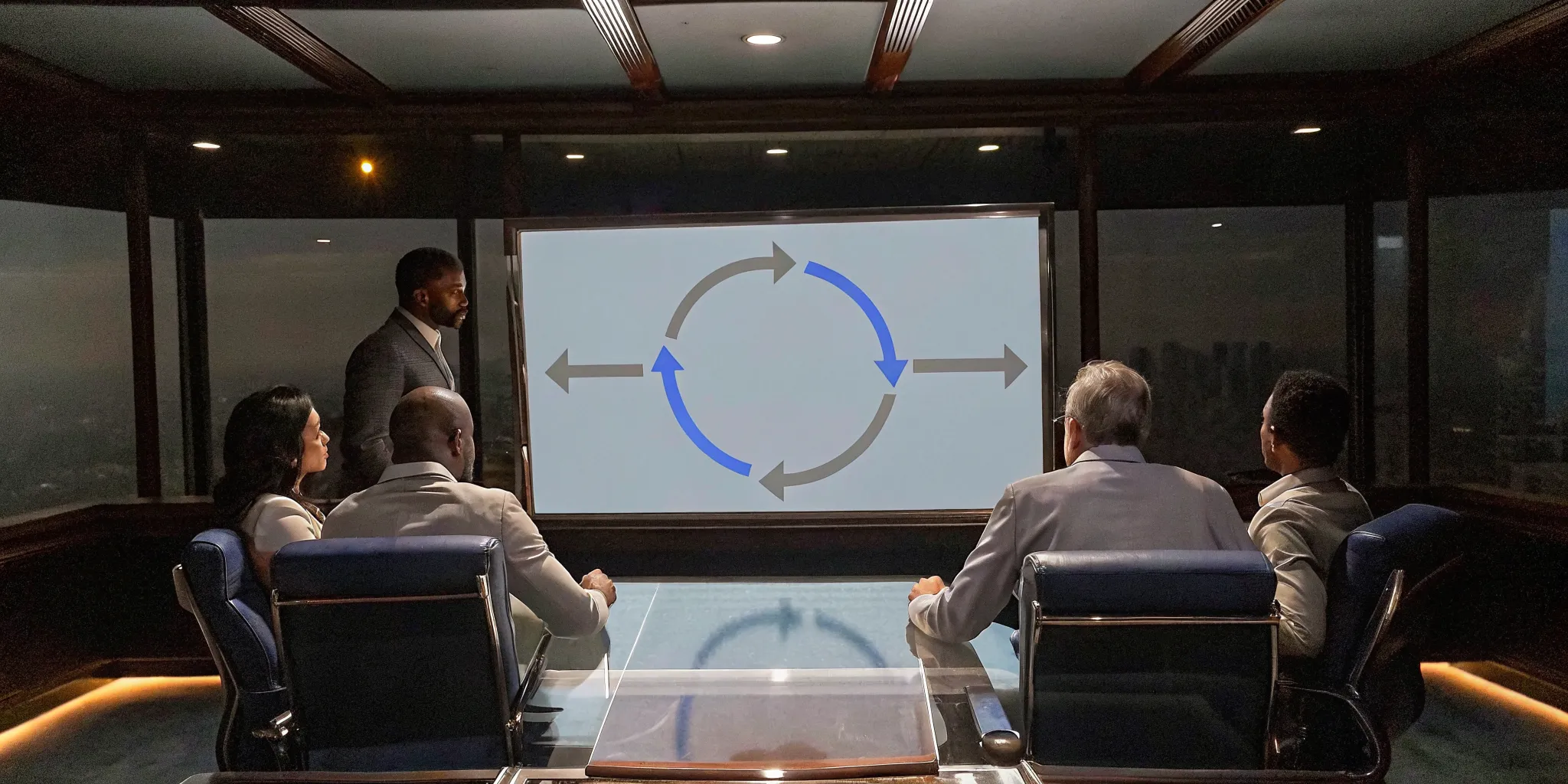
What Is the Flawless Execution Model?
Some quarters everything clicks. Your team hits the number, the energy is high, and you’re thinking, we’ve finally figured this out. Then next quarter, same people, same strategy, and the wheels fall off. Sound familiar?
See how scaling companies can apply this operating rhythm in our guide to Denver leadership training.
I’m Christian “Boo” Boucousis, CEO of Afterburner, and I spent over a decade as an F/A-18 Hornet pilot in the Royal Australian Air Force before building a career helping business leaders close the gap between strategy and results. Here’s what I’ve learned: when performance is inconsistent, the problem isn’t your people and it isn’t your strategy. It’s that you don’t have a system.
The flawless execution model is a simple, repeatable four-step cycle (Plan, Brief, Execute, Debrief) engineered from fighter pilot methodology to close the execution gap and turn strategy into measurable results. We call it FLEX, which stands for FLawless EXecution. It’s the same operational loop the U.S. Air Force has used for over sixty years. If it’s kept aircrew alive at 1,200 miles per hour, it’ll work in your boardroom.
Why I Stopped Chasing Perfection
Let me tell you what happened the first time I understood the difference between flawless and perfect.
I was twenty-one years old, sitting in the front seat of a Macchi jet trainer at Pearce Air Force Base. My instructor, a graduate of Australian Top Gun we called Muff, was in the back. Outside the canopy, the weather looked like someone had thrown a dark blanket over Western Australia: cold driving rain, erratic winds sweeping in off the Indian Ocean. The numbers said the weather was within limits. Barely. My course mate Beno was in the other jet, looking across at me. Engines running. Fuel burning. Every second on the ground felt like a wasted mission.
I felt enormous pressure to press on.
Muff said nothing. He could have called it off two hours earlier in the warm briefing room, coffee in hand. Instead, he put me in the jet, in the weather, with the mission clock ticking, and waited. He wanted to see the decision I’d make not in theory, but in the moment when every instinct was screaming just go.
I keyed the mic: “I’m calling it, sir. I’m not happy with the weather. I’m calling a weather abort.”
“Good decision, Boo. Let’s taxi back.”
On the taxi back, Muff told me about friends he’d lost. Not in combat. Pressing marginal situations. Pilots call it press-on-itis: the subconscious belief that everything will be okay if you just keep going. That morning, Muff invested a wasted sortie to teach me something no classroom ever could: flawless execution isn’t about being perfect. It’s about being 100% committed to what you can control and intelligently adapting to what you can’t.
There’s a saying widely attributed to Nelson Mandela: “I never lose. I either win or learn.” That’s the mindset behind FLEX. We can’t make your organization perfect. Not even the Navy’s Blue Angels would claim perfection after thirty years of flying. But we will drive your team closer to flawless execution, and a little better every tomorrow.
How the Plan-Brief-Execute-Debrief Cycle Works
At the heart of FLEX is a closed loop, not a checklist. Each step feeds the next, and the debrief feeds directly back into the next plan. That’s how compound growth works at the method level. Let me walk you through each phase.
Plan: See Your Future in High Definition
Here’s the thing about planning in most organizations: it’s vague. “Grow the business.” “Improve customer satisfaction.” Those aren’t plans. Those are wishes.
In FLEX, we don’t set goals. We define High-Definition Destinations, or HDDs. An HDD is a crystal-clear picture of what success looks like, specific enough that there’s no ambiguity about whether you’ve arrived. Not “grow the business” but “increase market share in mining by 800,000 gallons of fuel-oil per month by November 30.” One of our clients built exactly that HDD. They hit it in seven months and exceeded it.
The HDD test: can everyone on your team describe it in one sentence without checking a document? If not, it isn’t defined clearly enough yet.
FLEX planning runs through the Six Steps of Mission Planning:
Step 1: Set a mission objective aligned to your HDD. Clear, measurable, achievable, binary. Did we arrive? Yes or no. That’s the only acceptable answer.
Step 2: Identify threats, both internal and external, controllable and uncontrollable. If you have more than five, the mission is too big. Break it down.
Step 3: Identify resources. For each high-priority threat, attach a resource. Fight optimism bias deliberately. Every threat needs a person or tool matched against it.
Step 4: Evaluate lessons learned and make a Go/No Go call. Review ORCA (Objective, Result, Cause, Action) actions from previous missions. Do the resources outweigh the threats? If yes, go. If not, scale down. This is a real decision point, not a formality.
Step 5: Build your course of action, meaning who does what by when. Collaboratively. Binary. No “sort of” in execution.
Step 6: Build contingencies and Red Team the plan. A contingency has three parts: the event, the trigger, and the action. Then invite challenge. Red Teaming means someone outside your plan asks, “Have you considered XYZ?” The response is always “Thank you.” No debate. No defense. Challenge the plan before you’re challenged on your results.
The cascade works like this: the HDD shapes objectives. Objectives focus actions. Actions generate impact. When this cascade is working, every action on every team connects upward to the destination. When it breaks, teams execute energetically toward nothing in particular.
Brief: It’s Not What You Say, It’s What’s Understood
You’ll notice we don’t call this a meeting. Brief by name, brief by nature.
Once the plan is built, it has to live in the minds of the team. The mission leader walks through the plan step by step, using the same structure we used to plan the mission. The rule is simple: nobody leaves with unanswered questions. In a fighter squadron, we don’t want pilots thinking about their next step when they’re in the engagement. We want their minds free for the actual mission. The brief is what creates that freedom.
According to Verizon Conferencing’s “Meetings in America” study, 91% of people admit to daydreaming during company meetings. That’s not a brief. That’s a waste of everyone’s time. The simple rule of thumb with briefing: it’s not what you say, it’s what’s understood.
We use the BRIEF mnemonic to structure every briefing: Big Picture (why this mission matters), Restate the objective, Identify threats and resources, Execution (who does what by when), and Flexibility (contingencies and what-ifs). Finish with three things in equal measure: answer questions, confirm understanding, and close with a positive call to launch. Your last words should always be forward-looking. A brief that ends well is the right launchpad for the mission.
Execute: Fly the Brief
In most organizations, execution feels like the only step. Execute, execute, execute, and hope the targets get hit. Without the plan, brief, and debrief surrounding it, execution is just organized chaos with an irrelevant deadline.
The fighter pilot principle for execution is simple: fly the brief. You execute the course of action from Step 5 of the plan. You don’t improvise. You don’t drift. You don’t get pulled into the weeds of individual actions when you should be above them. The brief is the contract. Execution is honoring it.
That doesn’t mean rigidity. It means discipline. If something changes mid-execution (an unexpected threat materializes, a resource falls through, reality diverges from the plan) you adapt based on what the plan already told you to do. You don’t abandon the plan because it got hard. You deviate only when the evidence tells you to.
The most important execution discipline for a leader? Don’t fly the mission yourself. Stay above it. When pressure rises, leaders instinctively tighten their grip: more meetings, more approvals, more direct oversight. It feels like control. It’s actually the fastest way to saturate yourself and your team. In aviation, we call this channelized attention, so fixated on one thing that you stop seeing everything else. It’s the leading cause of fatal accidents in aviation because it’s default human behavior, the behavior that’s trained out of you as a fighter pilot.
Debrief: The Fighter Pilot’s Secret Weapon
The fact is, the debrief is where the real growth happens. It’s the step that separates teams that compound growth from teams that just accumulate time.
After every mission, pilots gather in a nameless, rankless room. General or cadet, senior leader or new hire, everyone speaks openly about what worked and what didn’t. Mistakes aren’t punished. They’re mined for insight. We use the ORCA framework:
- Objective: What did we set out to do?
- Result: What actually happened?
- Cause: Why was there a gap? Keep asking why until you find a person and a decision that caused it. Not “the market.” Not “bad timing.” A decision someone made.
- Action: What specifically will we do differently next time? One strong action that gets implemented is worth more than ten that don’t.
The New York Giants learned this during their 2011 season. Already strong at planning, briefing, and execution, they were missing the debrief. Once they adopted it, with players openly owning their mistakes and learning together week by week, they built the alignment and accountability that carried them to a Super Bowl XLVI victory over the New England Patriots in February 2012. The shift wasn’t in their talent. It was in their learning rate.
And critically: ORCA actions from this debrief feed directly into Step 4 of the next plan. That’s the loop closing. That’s feedback becoming action forward. That’s the 1% compounding.
Listen: Why Fighter Pilots Debrief Everything
Afterburner CEO Christian “Boo” Boucousis appeared on The Unfolding Thought Podcast to explore why the debrief phase of the Plan-Brief-Execute-Debrief cycle is where real improvement happens. Drawing on his F/A-18 Hornet experience, Boo explains how the ORCA debrief structure turns every mission outcome — good or bad — into actionable lessons, and why organizations that skip the debrief end up paying for the same mistake twice.
Watch the full episode:
Also available on Spotify and Apple Podcasts.
The X-Gap: Your Real-Time Situational Awareness Tool
Here’s something most people miss about FLEX. The system doesn’t just operate mission by mission. It operates at scale through the X-Gap.
The X-Gap (Execution Gap) is how you stay situationally aware during execution without micromanaging the team. It’s the discipline of periodically stepping back to ask one question: is what’s actually happening aligned with what we planned?
In fighter aviation, the debrief happens right after you land. The X-Gap happens when you sit down with your squadron commander and look at trends across twenty missions, analyzing whether your tactics are working, whether your training is effective, whether the strategy itself needs to change. One fixes today. The other sets the rhythm.
Everything you currently call a leadership meeting is actually an X-Gap waiting to be structured properly. Most meetings update what’s happened and debate what to do next. They have agendas, lists of topics to discuss, rather than a structured ORCA process. Giving those meetings an ORCA structure doesn’t add time. It replaces unfocused discussion with a disciplined learning conversation.
One of our clients, a midsize manufacturing company, was hitting quarterly revenue targets. On paper, everything looked healthy. But the CEO felt something was off. A monthly X-Gap revealed the truth: revenue was up 22%, but customer acquisition cost had increased 40%. Gross margin was down 8%. Sales team burnout was at an all-time high, and customer satisfaction was declining. The cause? The compensation structure rewarded closed deals, not profitable ones. Without the X-Gap, they would have kept “winning” until the business imploded.
How Flawless Execution Closes the Execution Gap
You’ve been there. You and your leadership team spend weeks crafting a brilliant strategic plan. The vision is clear, the goals are ambitious, the energy is high. A quarter later, the plan isn’t happening. That chasm between your strategy and your team’s actual performance is the execution gap, and it’s where most organizations fail. It’s not a strategy problem. It’s a systems problem.
FLEX closes it through three mechanisms:
Alignment through the brief. When every person on the team understands the mission, their role, and how their work connects to everyone else’s, you replace random acts of effort with focused action. The brief creates shared ownership before a single task begins.
Accountability through structure. During the Plan and Brief phases, roles and responsibilities are made crystal clear. Everyone knows what they’re accountable for before the work begins. This shifts accountability from a reactive, finger-pointing exercise to a proactive, shared responsibility.
Learning through the debrief. One percent better doesn’t sound like much. Compounded daily, it doesn’t make you 365% better by year’s end. It makes you thirty-seven times better. Small, intentional improvements done consistently demolish big, sporadic efforts. This is what fighter pilots call the accelerated learning curve, and it’s what separates dynasties from also-rans.
Who Gets the Most from Flawless Execution?
While any team can sharpen its performance with a better framework, FLEX delivers the most dramatic impact in three environments:
High-growth and transforming companies. When your organization is scaling quickly or undergoing significant change, processes break and priorities get lost. FLEX provides a stable, repeatable system when everything else feels like it’s in flux. Our 90-Day Accelerator is built for exactly this scenario.
Distributed and matrixed teams. When your team is spread across locations and time zones, alignment becomes your biggest challenge. The briefing step is specifically designed to create shared understanding before execution begins, preventing the fragmentation that plagues complex organizations.
Industries where mistakes are costly. Technology, finance, healthcare, manufacturing: any field where a breakdown in execution has serious consequences. FLEX was born from an environment where getting it wrong wasn’t just expensive, it was potentially fatal. That DNA carries through to every workshop and engagement we run.
How Afterburner Brings FLEX to Your Team
Understanding the model is the first step. Integrating it into your culture is what creates lasting results. We don’t just teach the theory. We guide your team through it to build the muscle memory for disciplined action.
Our keynotes introduce the core concepts in a way that gets everyone speaking the same language. For a deeper dive, our hands-on workshops help you apply FLEX to your most critical business challenges: not theoretical exercises, but your actual strategic plan built using the Six Steps of Mission Planning with expert facilitation.
And for leaders committed to lasting change, the 90-Day Accelerator embeds FLEX into your organization’s operating rhythm through consistent coaching and accountability. That’s how you move from a single successful project to a culture of continuous, flawless execution across the entire business.
Build Your Repeatable Operating System
When’s the last time you finished a quarter and felt like the result was inevitable, not lucky? That’s what a repeatable operating system gives you. Not heroic wins you can’t replicate, but a rhythm that makes excellence a habit.
FLEX gives you that rhythm. Plan with precision using the Six Steps. Brief until everyone understands, not just what they heard, but what they’ll do. Execute with discipline, staying above the action layer instead of drowning in it. And debrief every single time, turning every outcome into a deposit in the performance bank.
The curve doesn’t care about effort. It cares about learning rate. And learning rate is what FLEX is built to accelerate.
Frequently Asked Questions
What is the flawless execution model in simple terms?
The flawless execution model, known as FLEX (FLawless EXecution), is a four-step repeatable cycle: Plan, Brief, Execute, Debrief. Developed from fighter pilot methodology used by the U.S. Air Force for over sixty years, it gives organizations a systematic way to close the gap between strategy and results. The goal isn’t perfection. It’s 100% commitment to what you can control and intelligent adaptation to what you can’t.
How is Flawless Execution different from other project management frameworks?
Most frameworks focus on tracking tasks or managing timelines. FLEX is an operating system for how your team thinks and acts. It installs a rhythm that prioritizes alignment and continuous learning through the debrief. Instead of just managing the work, it improves how your team communicates, makes decisions, and adapts, skills they carry into every project.
Will implementing FLEX add more meetings to my team’s schedule?
The opposite, actually. FLEX is designed to replace inefficient, aimless meetings with short, focused communication. The upfront investment in a clear plan and a concise brief saves hours of confusion, rework, and unnecessary check-ins. Everything you currently call a meeting is an X-Gap waiting to be structured properly with ORCA.
How do you keep the debrief from becoming a blame session?
Structure. The debrief is a nameless, rankless process focused entirely on what happened during the mission, not who was responsible. By analyzing root causes using ORCA (Objective, Result, Cause, Action) the conversation shifts from finding fault to finding lessons. When your team knows they can speak openly without fear of reprisal, you get the honest feedback you need to actually improve.
What’s the best way to start implementing FLEX with my team?
Start small. Pick one upcoming project and commit to running the full four-step cycle from start to finish. The most critical part: follow through with a structured debrief at the end. When your team experiences the clarity and learning from just one cycle, they’ll see the value themselves. That’s the best way to build momentum for wider adoption. For a guided start, Afterburner’s workshops are designed to build exactly this muscle memory.
Related reading: Originals Flawless Execution | Our Approach